Saturday, 27 September 2014

A Garden Close Up


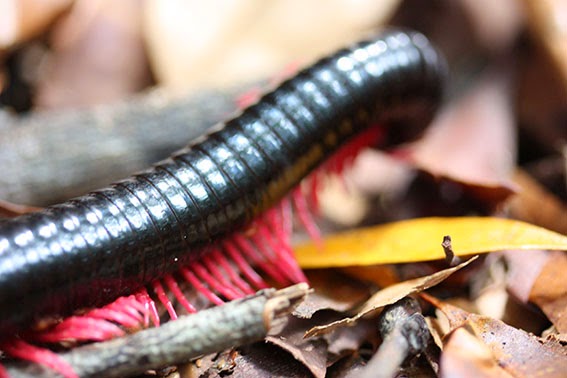
A generous lend of a macro lens from Jack Hobbs at the Auckland Botanic Gardens for my trip to the rainforests of Borneo has ensured a new addition to the ‘must have’ list for Christmas.

On return home from Malaysia where the focus of the lens was on miniature fungi hidden in the leaf litter and bizarre invertebrates (see below) I played around in my autumn garden – oh what a delight there is in seeing things from the perspective of a bee. 


It reminds me of the wise advice of an elderly gardener I used to visit as an 11 year old.  She had a large rambling garden full of roses and bulbs and some very sweet bantams (of whose eggs I always went home with).  Over a glass of lemonade and a biscuit, she would tell me to “always remember every day and all the tiny details of things – as one day I would wake and be her age (70+) with a wish to have spent more time observing and noticing the ‘beauty in little things’…


Wednesday, 10 September 2014

Favourite Plants


It’s never hard with our gorgeous array of New Zealand native plants but I’ve just fallen head over heals in love with two particular natives that now have pride of place in my Asian inspired Water courtyard and Merlot garden.
The first – Sporadanthus ferrugineus (giant wire rush) – is a restiad species from the domed bogs that were once found throughout the North Island (now restricted to a few in Waikato).  It grows to 2m in height and 2m width and its rust coloured seed heads and pendulous form are what first attracted me.    Not only will its graceful form look fantastic in front of the rust coloured fence backing the courtyard but I imagine its arching form gently stirring in the breeze, providing dappled shade over the low sun lounger on the deck overhanging the reflection pond.  An added bonus is that I will be assisting in the rescue of an at risk native plant and showing off its beauty in an unexpected situation.
The second is Psuedowintera colorata ‘Red devil’  (Mountain horopito) – whose mix of cream coloured leaves stained with red – almost as if the leaves have been sprinkled with droplets of a good claret -  are an absolute delight.  The genus is only found in New Zealand and its primitive flower structure hint at its ancient lineage.

As with many NZ natives the plant was also used by Maori for its medicinal qualities – which is just another great reason to include it in the garden!  The leaves have a hot peppery taste due to the main active component of polygodial (The NZ Association of Medical Herbalists note that this is one of the components of the ‘hot taste’ in peppery spcies common in traditional Japanese cuisine and it has been shown to exhibit significant fungicidal and antibacterial activity).  The leaves can be used as a seasoning on food and when my plants have had a chance to settle in I look forward to respectfully and very gently taking a few leaves to dry and crush into a horopito pepper – apparently very good with lamb and kumara dishes.
Some recent research shows that the greater the red staining the more polygodial is present and that this is thought to be a warning to herbivores to prevent predation of the leaves as they have increased chemical defences (in this case the peppery polygodial & anthocyanin compounds).

The horopito are planted as a low hedge around the edge of what will be a japanese hot tub location sitting within the middle of the merlot (red & burgundy) garden.

Tuesday, 9 September 2014

Spring


The welcome swallows have returned and taken up residence - one pair has been making their mud nest on the roof rafters of the new outdoor room.  I could spend hours just watching them.


Sunday, 24 March 2013

Three Colours - Blue, Red and White

When I first started creating my garden at Violet Hill I wanted to have a colour theme for the structural components.  The house is white, with red roof - a traditional New Zealand farm house colour scheme (which I think always look fantastic sitting within the green paddocks of rural NZ).   Oh those glorious rusty red coloured farm buildings are a real passion.


I have always been a bit of a francophile and I love blues in gardens - so a split complimentary colour theme formed that consisted of an ox blood red and smoky blue scheme - this wonderful house frontage in Christchurch is an inspiration for how effective this mix can be.  Brings back memories of my favourite french films by Krysztof Kieslowski - trios couleurs: bleu, blanc and rouge.  Blue, white and red being the colours of the french flag and the Kieslowski's films are based on the french republic political ideals of liberty, equality and fraternity.

These images from the blog of Nichole Robertson a photographer working in France are so evocative of the intensity that these two contrasting colours can provide - I just adore them - they seem to have a real vibrancy.


These colours are beautiful together and within the context of the garden and plants provide some real interest and a bit of unexpected fun.

In fact, I have used Resene 'burnt crimson' and 'lynch' as the key paint colors.  These colour themes have guided a number of the features in the garden - including a recently completed mosaic paving feature.


Gates


And more gates


Pots


Shepherds Hut


Archways


Now what I need to plan is a stunning red colour themed garden like the inspiring and beautiful garden at Ellerslie Flower show a few years ago by Sir Miles Warren.


Sunday, 3 March 2013

Pebble Mosaic Path


One of my summer projects was to complete a pebble pathway down the centre of the potager.  This links to an earlier pebble feature I created in the front of the glasshouse.  I love the look of pebble mosaic and it is a very calming activity to place pebbles - i've linked in the pattern the old terracotta bricks that are a recurring material throughout the garden.  Our neighbour just gave us 1200 more - so there will be more brick paving to come and I like the concept that i'm recycling - well actually in truth it's probably more upcycling as I think the brick pathways are a bit classier than a chimney!.


Friday, 1 March 2013

Living Roof for Chook Shed


In early summer I took inspiration from a living roof (described to me by a Polish ecologist researching the building) that was put onto a large chicken farm in Switzerland (below).  This living roof was established to provide temperature and ventilation control for the hen unit and to integrate it within the rural landscape in which the farm is located. 


The green roof controls temperature and ventilation inside the building.  In summer the interior temperature is reduced by 7 degrees due to the cooling effect of evapotranspiration of the plants on the roof.  In winter the improved insulation helps to keep temperatures constant.

By all accounts the hens egg production has improved due to the quality of life and comfort of the hens being improved by the ventilation and temperature control. 

So I set about retro-fitting my small chook house with a living roof using NZ native plants.  It was an easy and quick job (no more than 1/2 day all up).  The drawing below shows how the retrofit was designed for the chook house.


The roof not only looks great, but anecdotally seems to have created a nicer environment inside the shed - hopefully happy and cool hens in summer will mean more eggs.  I wrote an article recently for Organic NZ magazine about living roofs profiling this project. 

Despite the long hot summer (and without any watering) the living roof has survived its first summer really well and the muehlenbeckia looks great hanging down over the edge.


A fellow living roof researcher has also designed a living roof for their chook shed - it's in the shade so has been able to utilise NZ native plants that prefer shady environments - also very nice shed which you look down on from the house so looks great with a greened aesthetic.


Rustic Art Installation


Finally decided on a location for a terracotta sculpture that I purchased over 10 years ago on a trip to Tasmania with my mum and brother.  It is an Australian marsupial - the sugar glider (Peaurus breviceps - a gliding possum that lives in trees in Australia).

I decided on a lichen covered totara fence post collected on a trip to Taranaki - from an old abandoned Tarata shearing shed (I have a real obsession with old rural materials - rust, silvered timber and wire).  So the sugar glider now has pride of place in a corner of the potager.